Adaptations of plants for photosynthesis: gas exchange and stomata
Lesson 3 / 4
Lesson video
Lesson slides
Lesson details
Lesson outcome
Waxaad sharxi kartaa sida dhirta ugu la qabsanayaan inay qaataan oo sii daayaan gaasaska si ay u taageeraan photosynthesis.
Introduction
In this lesson: You can describe how plants are adapted to take in and release gases to support photosynthesis. Plant leaves take in carbon dioxide gas from the air for photosynthesis The oxygen made by photosynthesis is released as a gas from leaves into the air
Show transcript
Worksheet
not available yet
Quizzes
1. Which part of a plant takes in gas for photosynthesis **and** releases gas made by photosynthesis?
- flowers
- Correct answer:leaves
- roots
2. Carbon dioxide gas and oxygen gas are made up of _____ .
- air
- cells
- minerals
- Correct answer:particles
3. When particles of a gas move from one place to another, this is called _____ .
- adaptation
- concentration
- Correct answer:diffusion
- reproduction
4. The diagram shows particles of a gas. Which statement is correct?
- Correct answer:More of the particles will move from **area A** to **area B**.
- More of the particles will move from **area B** to **area A**.
- The same number of particles will move between both areas.
- The particles will **not** move.
1. What is the name of the tiny holes in the surface of a leaf?
- chloroplasts
- guard cells
- Correct answer:stomata
- vacuoles
2. The diagram shows some structures that make up a plant’s leaf. Which part of the diagram shows one of the leaf’s stomata?
- Part **A**
- Part **B**
- Part **C**
- Correct answer:Part **D**
3. Which process allows gas exchange through open stomata during photosynthesis?
- adaptation
- concentration
- Correct answer:diffusion
- respiration
4. Which diagram shows the correct **concentration gradient** of particles of **oxygen** gas when the cells inside the leaf are photosynthesising?
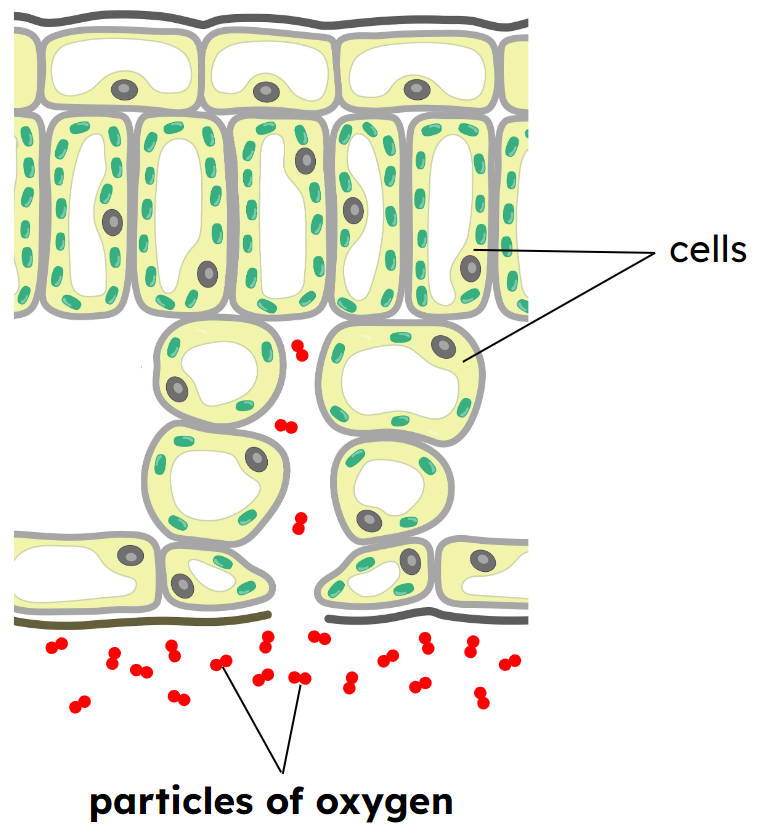 Diagram **A**
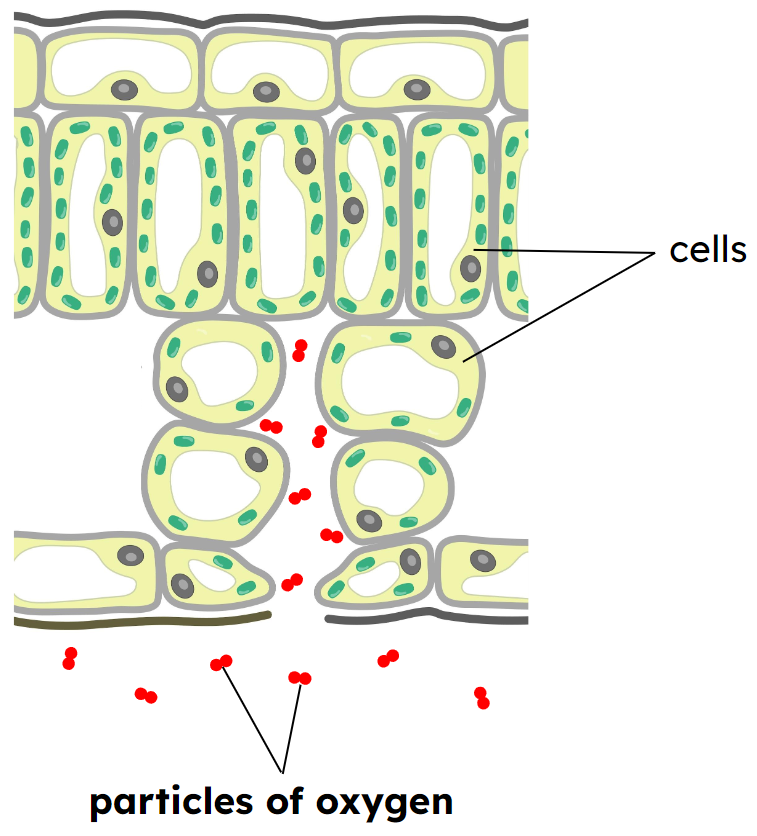 Diagram **B**
- Correct answer:
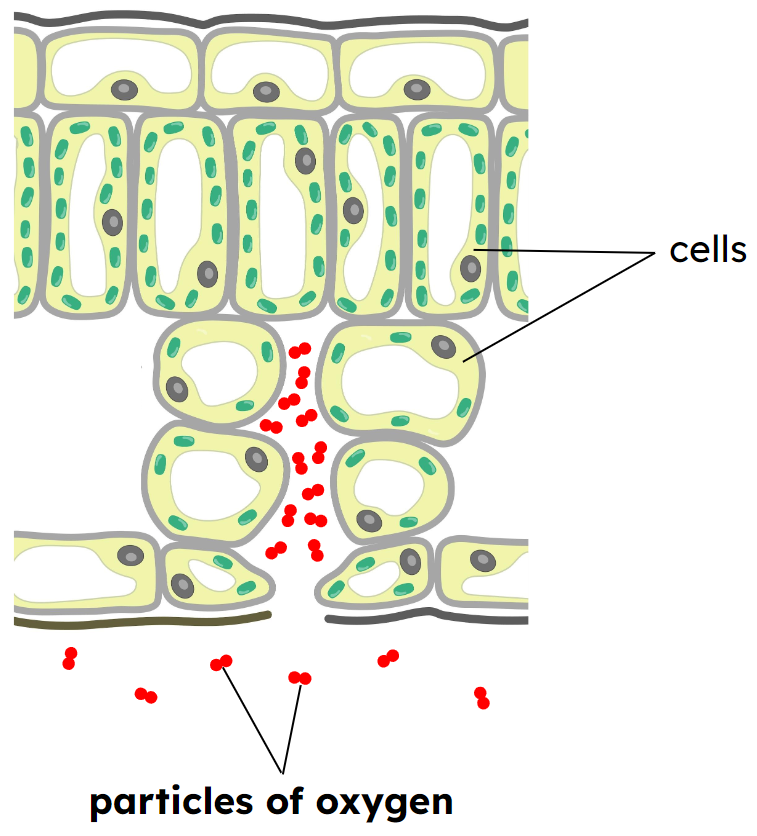 Diagram **C**
5. Which statement describes the **net movement** of carbon dioxide particles when the leaf cells are photosynthesising?
- Net movement in both directions.
- Net movement **from** inside the leaf **to** the outside.
- Correct answer:Net movement **from** the outside **to** inside the leaf.
- No net movement in either direction.
What pupils see
The same lesson as a pupil sees it. You can set any section as work on its own.
- IntroductionPrepare
- Starter quizActivate · 4 questions
- Lesson videoLearn
- Exit quizCheck · 5 questions