Focusing light
Lesson 1 / 7
Lesson video
Lesson slides
Lesson details
Lesson outcome
Waxaan sharxi karaa sida iftiinka ka yimaada shay uu muraayad isku-urursan (converging lens) ugu diiradda saaro si uu u sameeyo sawir.
Introduction
In this lesson: I can explain how light from an object can be focused by a converging lens to form an image. Some of the light from objects can pass through a lens and become focused to form an image on a screen. Some light from every point on an object passes through every part of a lens.
Show transcript
Worksheet
not available yet
Quizzes
1. Which of the following statements are correct?
- Correct answer:Each point on a luminous object emits light in all directions.
- Each point on a luminous object emits light in one direction.
- Correct answer:Each point on a non-luminous object reflects light in all directions.
- Each point on a non-luminous object reflects light in one direction.
2. A pupil holds up a screen to face the full Moon at night. Which of the following explains why an image of the Moon does not appear on the screen?
- No light from the Moon hits the screen.
- The light rays hitting the screen are virtual.
- Correct answer:Light from every part of the Moon hits every part of the screen.
- Each point on the screen is hit by light from only one point on the Moon.
3. A light ray passes from air into a glass block, but it is not refracted. Which of the following statements can explain this?
- Transmission and refraction cannot happen together.
- Correct answer:The ray meets the glass along the normal to the block’s surface.
- The ray meets the glass at 90° to the normal to the block’s surface.
- Refraction does not happen when light passes from air into a solid.
4. Light crosses a boundary from one material into another. Which of the following statements is correct?
- Correct answer:The greater the angle between a ray and the normal, the more it is refracted.
- The smaller the angle between a ray and the normal, the more it is refracted.
- The angle between a ray and the normal doesn't affect how much it is refracted.
5. Which of the following diagrams correctly shows light refracting through a rectangular block?
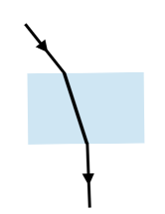
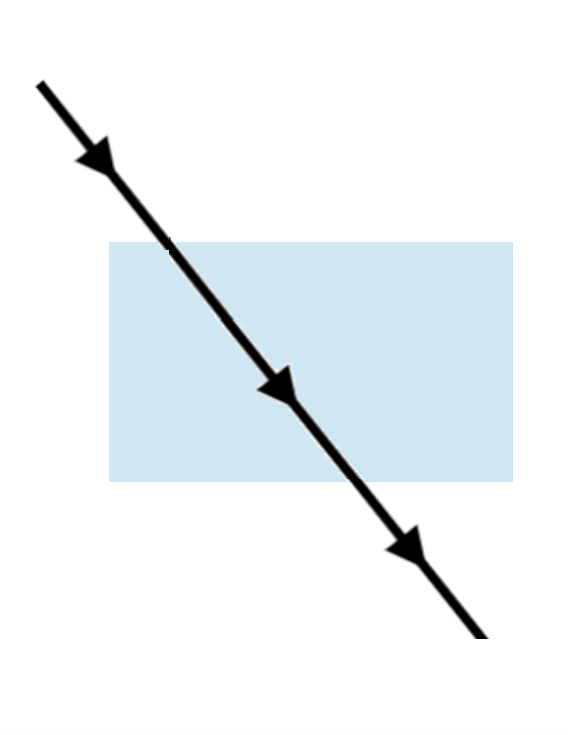
- Correct answer:
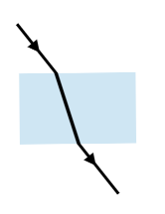
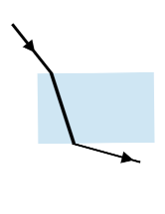
1. Which of the following statements about images made on a screen by a convex (converging) lens is correct?
- A larger lens produces a larger image.
- The image can be rotated by turning the lens.
- The image is always the same size as the object.
- Correct answer:The image is always inverted compared with the object.
2. A pupil wants to use a lens to make an image of a bright object appear on a screen. Where should the pupil put the screen to see a clear image?
- at the focal distance from the lens
- closer to the lens than the focal distance
- further from the lens than the focal distance
- Correct answer:It depends on the distance between the lens and the object.
3. The more powerful a lens is, the shorter its focal length. Which of the following changes would make a lens more powerful?
- Correct answer:making the lens wider (more curved)
- making the lens thinner (less curved)
- making the lens from a material that refracts light less
- Correct answer:making the lens from a material that refracts light more
4. The diagram shows a lens focusing light from a tree. Three of the rays are shown. At which of the labelled distances is an image formed?
- A
- B
- C
- Correct answer:D
- E
5. Which of the following happen when a lens forms an image of an object?
- All rays from one point on the object pass through the same part of the lens.
- Correct answer:All rays from one point on the object arrive at the same point in the image.
- Correct answer:Rays from all points on the object pass through each part of the lens.
- Rays from all points on the object arrive at the same point in the image.
6. The image shows a convex lens. Which of the following statements about the lens is correct?
- All parts of the lens refract light equally.
- The thickest part of the lens refracts light most strongly.
- Correct answer:The thinnest parts of the lens refract light most strongly.
What pupils see
The same lesson as a pupil sees it. You can set any section as work on its own.
- IntroductionPrepare
- Starter quizActivate · 5 questions
- Lesson videoLearn
- Exit quizCheck · 6 questions