Loops of a parallel circuit
Lesson 4 / 9
Lesson video
Lesson slides
Lesson details
Lesson outcome
Waxaan u qaybin karaa wareegga barbar socda (parallel) qaybo taxan (series) oo isku xiran.
Introduction
In this lesson: I can divide a parallel circuit into a set of nested series circuits. In a parallel circuit, each loop can be traced from one end of the cell or battery to the other end. Each loop in a parallel circuit is equivalent to a series circuit connected to the same cell or battery.
Show transcript
Worksheet
not available yet
Quizzes
1. Which of the following statements about the electrical leads in laboratory circuits is correct?
- The leads oppose the flow of current.
- Unconnected leads have a voltage across them.
- Correct answer:The leads have negligible resistance.
2. Which of the following is the more formal term for voltage?
- rational difference
- potential reference
- Correct answer:potential difference
- rational reference
3. Which of the following is the correct way to connect a voltmeter and an ammeter in a circuit?
- Correct answer:Connect the voltmeter in parallel and the ammeter in series.
- Connect the voltmeter in series and the ammeter in parallel.
- Connect both the voltmeter and the ammeter in parallel.
- Connect both the voltmeter and the ammeter in series.
4. Which of the following statements about the voltage in the branches of the parallel circuit shown is correct?
- The branch with the single lamp has a higher voltage.
- The branch with two lamps has a higher voltage.
- Correct answer:Both branches have the same voltage.
- The branches with lamps have a lower voltage than the cell.
5. All of the lamps in the circuit shown are identical. What is the voltage across lamp 3?
- 1.0 V
- Correct answer:2.0 V
- 3.0 V
- 4.0 V
6. What will the reading be on voltmeters 1 and 2 in the circuit shown?
- voltmeter 1: 3.0 V, voltmeter 2: 3.0 V
- voltmeter 1: 1.5 V, voltmeter 2: 1.5 V
- Correct answer:voltmeter 1: 3.0 V, voltmeter 2: 0.0 V
- voltmeter 1: 0.0 V, voltmeter 2: 3.0 V
1. Which of the following statements about circuits are correct?
- Correct answer:A parallel circuit can be made up of separate series circuits.
- A series circuit has multiple loops.
- Correct answer:A parallel circuit has junctions.
- A series circuit has different current values at different points in it.
2. Which of the following circuits is the odd one out?
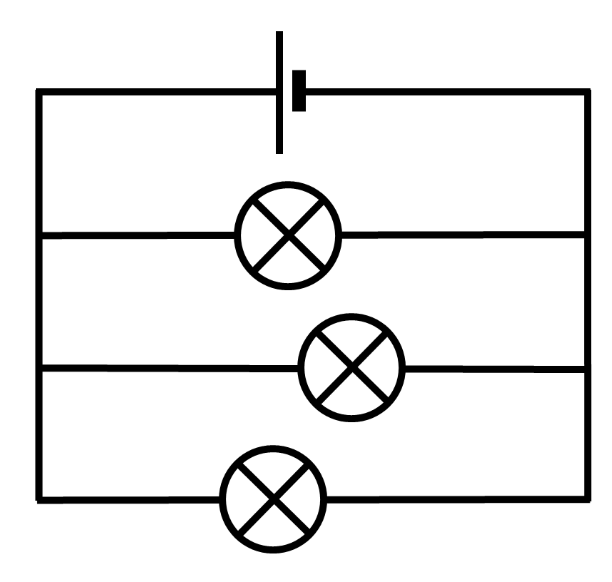
- Correct answer:
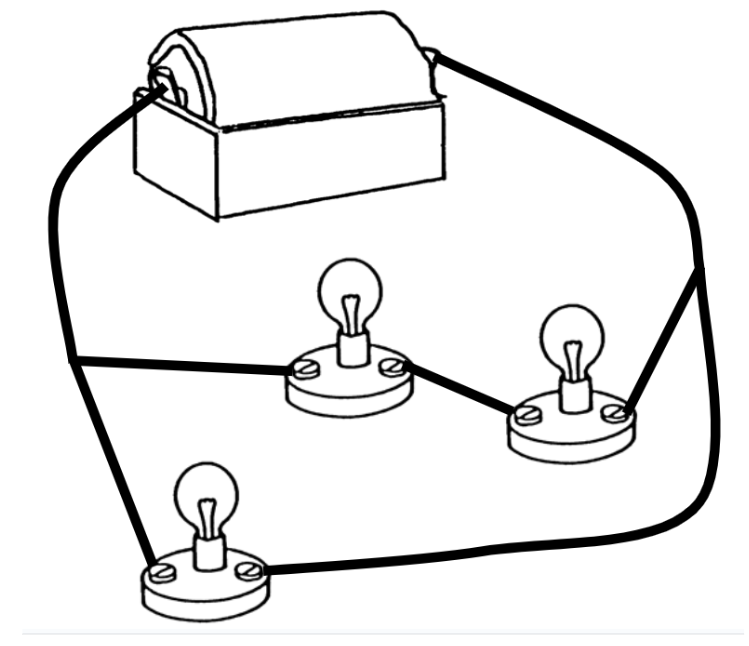
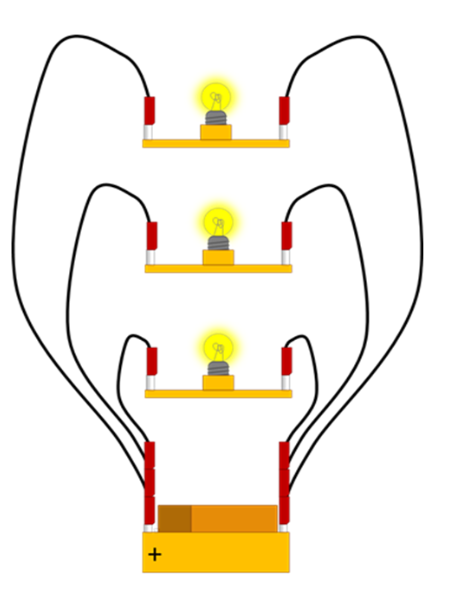
3. All of the lamps in the circuit shown are identical. Which of the following statements is correct?
- The lamps will be different brightnesses.
- Correct answer:The lamps have the same voltage.
- The lamp nearest the cell will get the highest voltage.
- The current reduces through each lamp with distance from the cell.
4. What is the voltage of a battery of four 1.5 V cells, connected in the same direction in series?
- 1.5 V
- 3.0 V
- 4.5 V
- Correct answer:6.0 V
5. Which of the following can be used to help explain potential difference?
- Correct answer:energy in the gravitational store
- energy in the elastic store
- energy in the chemical store
6. Which of the following statements about connecting identical cells in parallel is correct?
- The voltage increases.
- They can 'push' current harder.
- Correct answer:They can light a lamp for longer.
What pupils see
The same lesson as a pupil sees it. You can set any section as work on its own.
- IntroductionPrepare
- Starter quizActivate · 6 questions
- Lesson videoLearn
- Exit quizCheck · 6 questions